
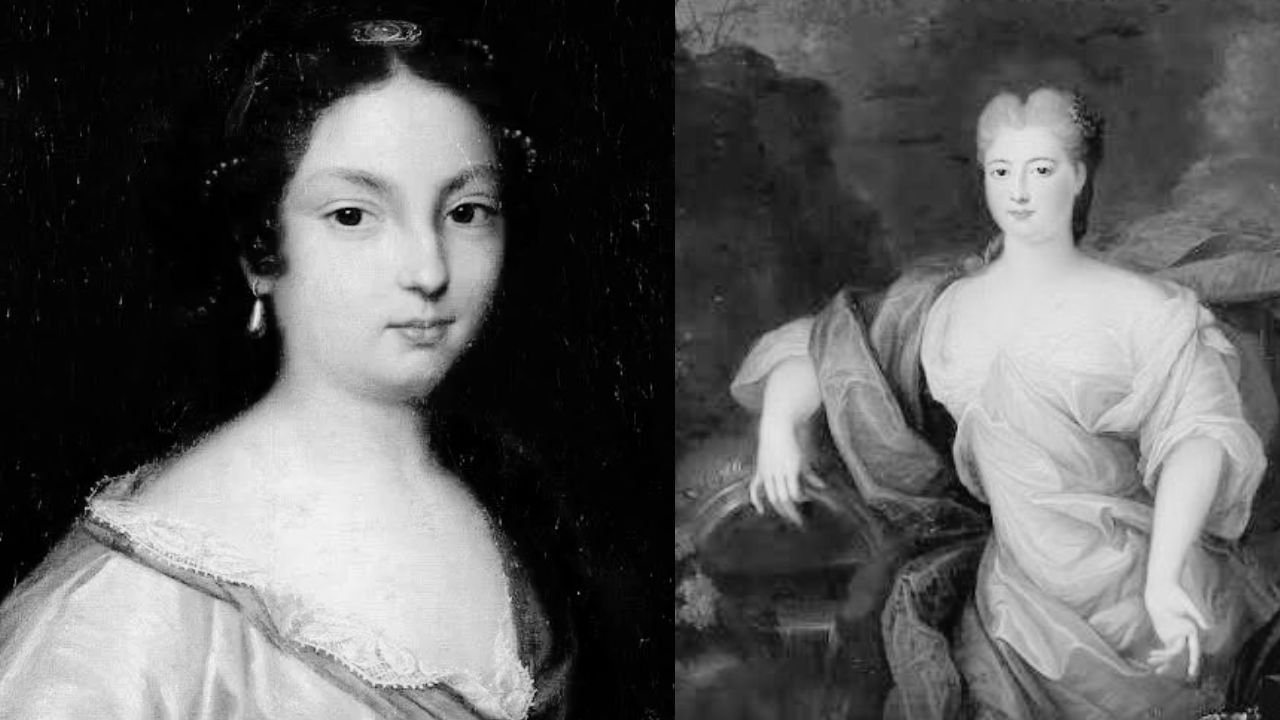
Most of Louis XIV’s illegitimate children were publicly acknowledged and given titles, estates, and places at the French court. Louise de Maisonblanche was not one of them. Her name appears in genealogical records, family trees, and historical footnotes — but never in a royal decree of recognition.
This article covers who Louise de Maisonblanche was, the disputed claim that Louis XIV was her biological father, who her mother was, and why she was never formally recognized. It also looks at her marriage, her descendants, and how to read the genealogical records that keep her name in circulation today.
Who Was Louise de Maisonblanche?
Louise de Maisonblanche was born in Paris on 17 June 1676. She died on 12 September 1718, recorded at La Queue-les-Yvelines. Those are the two dates that anchor almost everything known about her life.
Her official birth records name her parents as Philippe de Maisonblanche and Gabrielle de La Tour. Later historical accounts suggest this parentage may have been a formal arrangement rather than her true biological origin — but that interpretation is based on historical tradition, not universally documented proof.
Through her marriage to Bernard de Prez, she acquired the title Baronne de La Queue, which is why she sometimes appears in records as the Baroness of La Queue. Some documents connected to her children describe her as “Dame Louise de Bourbon-Maisonblanche, fille naturelle du Roi” — meaning natural daughter of the king. That phrase reflects a family or local tradition of claiming royal descent. It is not the same as legal recognition from the crown.
It is worth knowing what “natural daughter” meant in early modern France. The term referred to a child born outside of marriage. It did not automatically mean the child had no social standing or known family. Noble families and even royal households dealt with such situations regularly, and outcomes varied widely depending on the monarch’s willingness to act.
Her Mother, Claude de Vin des Œillets
The royal paternity claim begins with Louise’s mother: Claude de Vin des Œillets, commonly known as Mademoiselle des Œillets. She is the central figure in understanding why Louis XIV’s name became attached to Louise at all.
Claude served in the household of Françoise-Athénaïs de Rochechouart, the Marquise de Montespan. Montespan was one of Louis XIV’s most prominent and long-standing mistresses. Her household placed Claude physically close to the king over a sustained period, which is the foundation of the paternity claim.
However, Claude de Vin des Œillets had more than one lover during this period. That fact is key. According to historical accounts, it was precisely this uncertainty that led Louis XIV to doubt his own paternity. He reportedly questioned whether Louise was his child — and he took no official steps to recognize or legitimize her as a result.
Claude’s position near Montespan’s inner circle is well documented. Her personal relationship with the king is described in historical sources but carries less certainty. Readers should treat the connection as a plausible but unproven historical claim rather than an established fact.
The Royal Paternity Claim and Why It Was Never Settled
To understand Louise’s situation, it helps to compare her case with Louis XIV’s acknowledged children. The king formally recognized and legitimized several children born outside his marriage — most famously those he had with Louise de La Vallière and with Montespan herself. These children received ducal titles, estates, and official positions at court. Their royal status was a legal fact, not just a family story.
Louise de Maisonblanche received none of that. She was never legitimized. She was never publicly acknowledged by the king. Whatever the truth of her biological origins, she had no legal standing as a Bourbon child during her lifetime.
The reason most often cited in historical accounts is the king’s doubt about paternity. Because Claude de Vin des Œillets had other relationships, Louis XIV was reportedly unwilling to make a formal claim. Some accounts note that Louise bore a physical resemblance to the king, but resemblance was never treated as sufficient grounds for official recognition in seventeenth-century France.
The official birth record naming Philippe de Maisonblanche and Gabrielle de La Tour as her parents remains the documentary baseline. Later accounts that characterize this parentage as a cover arrangement are part of the historical interpretation surrounding her case — they are not confirmed in the same way that the birth record itself is.
This distinction matters. There is a real difference between a family tradition of claiming royal descent and a legally documented royal lineage. Louise’s story illustrates that gap clearly.
Marriage, Title, and Family Life
Whatever uncertainty surrounds her origins, the facts of Louise’s adult life are somewhat clearer. She married Bernard de Prez and through that marriage became the Baronne de La Queue — a title tied to the estate of La Queue-les-Yvelines, where she was recorded at her death in 1718.
Louise and Bernard had 11 children together. Six of those children survived infancy, which was not unusual for the period. Those surviving children and their own descendants are the main reason Louise de Maisonblanche appears so frequently in genealogical research today.
Researchers tracing family lines through Bernard de Prez will encounter Louise under several different name forms: Louise de Maisonblanche, Louise de Bourbon-Maisonblanche, and Baroness of La Queue are all versions found in family trees and historical records. Knowing that these names refer to the same person can prevent significant confusion when working through records.
How to Read the Genealogical Records?
Louise de Maisonblanche appears on platforms like Geni and MyHeritage, where user-submitted family trees have carried her name and dates into searchable databases. Her Geni profile lists her 1676 birth in Paris and her 1718 death at La Queue-les-Yvelines, along with family connections.
These platforms are useful starting points for genealogical research, but they should not be treated as final proof of disputed claims. User-submitted trees can repeat unsourced family traditions without distinguishing them from documented facts. A name appearing in a family tree is a research lead, not a confirmed historical finding.
The more reliable approach is to look for attached primary records — baptismal records, marriage registers, death records — and trace the documentation back as far as it goes. In Louise’s case, the birth record names Philippe de Maisonblanche and Gabrielle de La Tour. The family tradition naming Louis XIV as her biological father is found in later records connected to her children, not in her own birth documentation.
For anyone researching their own family history and finding a connection to Louise de Maisonblanche, the same approach applies: compare records, note what is documented versus what is traditional, and avoid treating any single genealogy site entry as conclusive. Resources like BuildBusinessDaily cover a range of research and reference topics that can help readers think critically about sources.
Where Louise Fits in the Wider Story of Louis XIV’s Court?
Louis XIV reigned for over 72 years. His court at Versailles was one of the most elaborate in European history, and his personal relationships produced a number of children outside his marriage. Several of those children were publicly acknowledged and went on to hold significant titles.
Louise de Maisonblanche sits at the edge of that world — connected to it through her mother’s service in Montespan’s household, and perhaps through biology, but never formally welcomed into it. Her story shows how the king’s recognition was the deciding factor. Without it, even a child who may have genuinely been of royal descent had no official claim to that identity.
She lived and died as a French noblewoman and baroness, not as a recognized Bourbon princess. That is the documented reality of her life, regardless of what her ancestry may or may not have been.
A Clear-Eyed Summary
Louise de Maisonblanche was a French noblewoman born in 1676 and died in 1718. She is traditionally described as the alleged illegitimate daughter of Louis XIV, born to Claude de Vin des Œillets, a woman who served in the household of the Marquise de Montespan.
The king never acknowledged or legitimized her. His reported doubt about his own paternity — stemming from Claude’s other relationships — appears to be the primary reason. Her official birth record names different parents entirely.
She married Bernard de Prez, became Baronne de La Queue, had 11 children, and died in La Queue-les-Yvelines. Her descendants are the reason her name continues to appear in genealogical research today.
Her case is a good reminder that historical claims about royal ancestry deserve careful reading. The tradition connecting her to Louis XIV is long-standing and may have a real basis — but tradition and legal documentation are not the same thing, and in Louise’s story, they never quite aligned.
Read Also: